


QERKY.ORG is about Quantum Education and Research in KentuckY.
The primary focus is on the interactions between the fields of quantum physics
and computer engineering, but all things related to quantum computing, communication,
and phenomena are valid topics. This site is maintained by Prof. Dietz at the University of Kentucky and began
as a branch from his Aggregate.Org research group on
May 5, 2019. All people in involved in quantum research and/or education in the Commonwealth
of Kentucky are invited to submit their info, links, and content for QUERKY.ORG to
Prof. Dietz via email to hankd@engr.uky.edu.
Overviews
-
March 5, 2025: Henry Dietz,
What Every Computer Scientist Should Know About Quantum Computing,
Computer Science Keeping Current seminar at the University of Kentucky,
(slides, video)
-
November 3, 2021: Tyler Burkett,
The Basics of Quantum Computing,
Computer Science Keeping Current seminar at the University of Kentucky,
(slides,
video)
-
October 11, 2017: Henry Dietz,
How Low Can You Go?,
Languages and Compilers for Parallel Computing workshop
(slides, paper) --
a white paper discussing how to dramatically reduce power consumed by computations using
the combination of bit-level compiler optimizations and quantum computation
Notices
-
Alfred Shapere (PHY DUS) and Henry Dietz (CPE DUS) have started work
toward a new Undergrad Certificate Program in Quantum Computers. The
certificate would primarily target PHY, CPE, EE, and CS majors, and
would combine fairly deep understanding of the quantum phenomena and
models from the physics program with conventional and quantum computer
architecture and system design from the computer engineering program.
The idea is for students to not only understand what happens inside a
QPU, but also how QPUs are integrated into complete computing systems.
We hope to have a certificate proposal ready by the end of Summer
2026. If you would like to help shape this program, please contact
Professors Shapere and Dietz.
News
-
November 16-19, 2026:
The University of Kentucky / Aggregate.Org research
exhibit at the IEEE/ACM SC26
International Conference for High Performance Computing,
Networking, Storage, & Analysis will be Booth 5637,
officially joining the Quantum
Junction exhibit cluster. This is our 33rd
year as an SC exhibitor, which began with Prof.
Dietz's SC94 exhibit showing how his group, then at
Purdue University, built the world's first Linux PC
cluster supercomputer.
-
June 11, 2026:
Prof. Dietz was interviewed by WKYT TV on June 9 for Data Centers Popping Up Across Kentucky, aired June 11.
His segment ended with a brief summary of his quantum-inspired
work on dramatically reducing power consumption.
-
April 3, 2026:
Prof. Dietz presented "Computing, Quantum" (slides)
in the UK Phy770 seminar series, 2-2:50PM in room 297,
Chemistry-Physics Building.
-
March 13, 2026:
Due to server hardware problems, QERKY.ORG has moved to
a new server. At this time, only HTTP and not HTTPS
access is supported.
-
February 28, 2026:
From 10AM-2PM, the University of Kentucky College of
Engineering held it's Engineer's Day Open House. The exhibits from the ECE
department included Prof. Dietz's
Quantum Computing.
-
November 17-20, 2025:
The University of Kentucky / Aggregate.Org had a
research exhibit at
IEEE/ACM SC25.
-
March 5, 2025:
Prof. Dietz presented What Every Computer Scientist Should Know About Quantum Computing
as part of the Keeping Current Seminar series. Here's the video of the talk.
-
February 22, 2025:
From 10AM-2PM, the University of Kentucky College of
Engineering held it's Engineer's Day Open House. The exhibits from the ECE
department included Prof. Dietz's
How does a Quantum Computer solve a problem?, as seen on TV.
-
January 2025:
Congrats to Refaat Ismail on completing his Ph.D.: Interplay Between Computational Techniques and Quantum
Theory: Advancing Quantum Chaos and Quantum Error
Correction
Major Research Areas By Topic
Researcher Links
Individual researchers generally have publications and other info
reachable from the pages linked here.
-
Tyler Burkett, M.S.,
Systems Professional II (ITS-RCI),
Computer Science, University of Kentucky:
QuantC: a CUDA-inspired language for quantum computing
-
Sen-ching "Samson" Cheung, Ph.D.,
Professor,
Electrical and Computer Engineering, University of Kentucky:
Cybersecurity and encryption
-
Lance De Long, Ph.D.,
Associate Director of University of Kentucky Center for Advanced Materials,
Professor,
Physics and Astronomy, University of Kentucky:
Superconducting and magnetic properties of materials
-
Henry "Hank" Dietz, Ph.D.,
Professor and James F. Hardymon Chair in Network Engineering,
Director of Undergraduate Studies for Computer Engineering,
Electrical and Computer Engineering, University of Kentucky:
Quantum and quantum-inspired computer system architecture,
programming languages, and compilers
-
Terrence Draper, Ph.D.,
Professor,
Physics and Astronomy, University of Kentucky:
Quantum chromodynamics (QCD)
-
Anatoly Dymarsky, Ph.D.,
Professor,
Physics and Astronomy, University of Kentucky:
High-energy physics, quantum mechanics, quantum error correction
-
Paul Eberhart, Ph.D.,
Lecturer,
Electrical and Computer Engineering, University of Kentucky:
Quantum-inspired computer systems
-
Michael Eides, Ph.D.,
Professor, APS Fellow,
Physics and Astronomy, University of Kentucky:
Quantum field theory, QCD
-
J. Todd Hastings, Ph.D.,
Associate Dean for Research and Graduate Studies,
Professor and Lighthouse Beacon Foundation Eminent Scholar,
Electrical and Computer Engineering, University of Kentucky:
Nanotechnology, nano-fabrication, and quantum devices
-
Alfred Shapere, Ph.D.,
Professor, Director of Undergraduate Studies,
Physics and Astronomy, University of Kentucky:
Information-theoretic codes in quantum fields
-
"Thomas" Tie Luo, Ph.D.,
Associate Professor,
Electrical and Computer Engineering, University of Kentucky:
Computer security
-
Ishan Thakkar, Ph.D.,
Associate Professor,
Reese S. Terry Professor,
Electrical and Computer Engineering, University of Kentucky:
Emerging computing technologies, spintronics
Major Research Exhibits
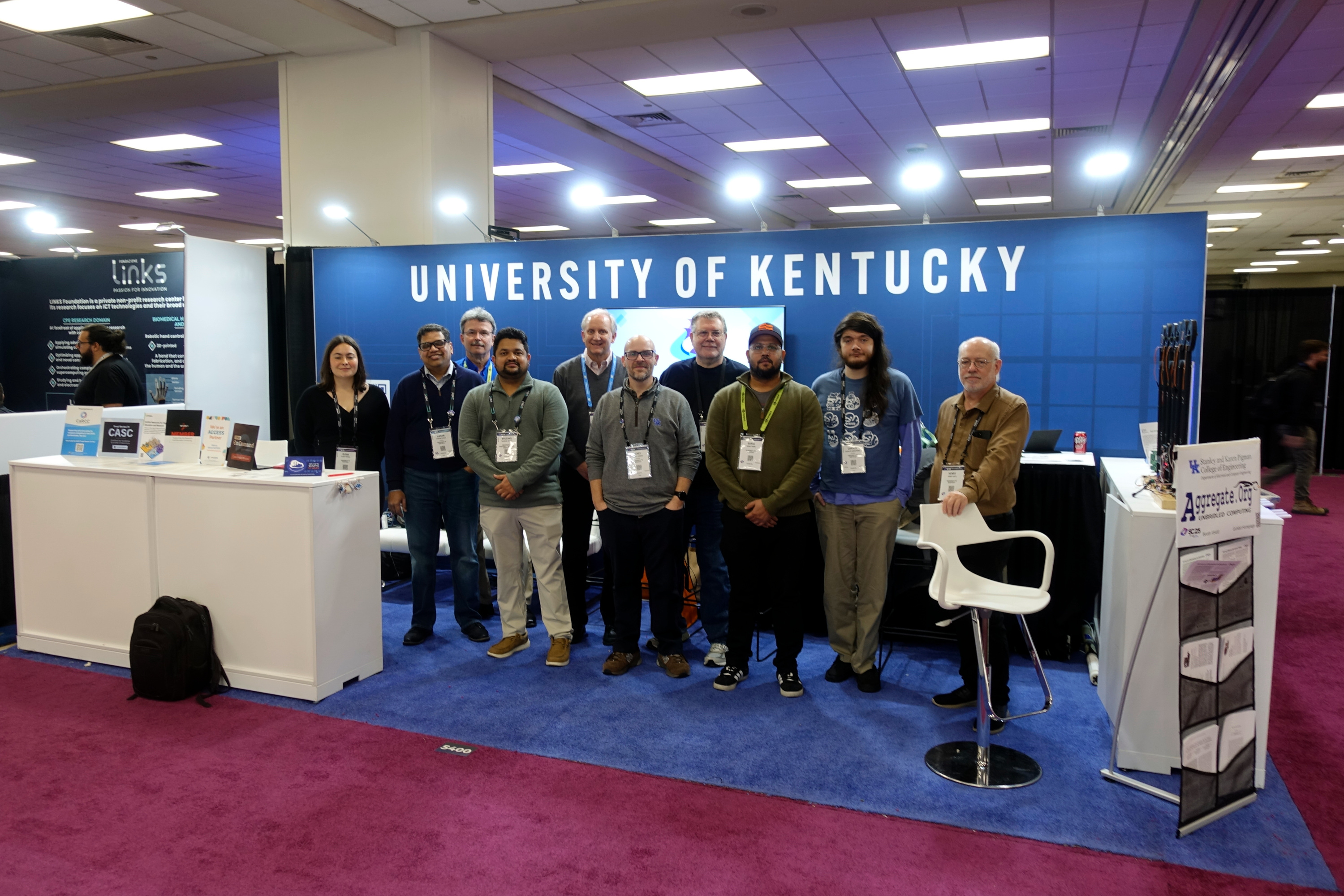

Quantum computing has been a major component of University
of Kentucky research exhibits since 2018. These exhibits
have been created and staffed as a joint effort between
the UK Center for
Computational Sciences (a supercomputing facility
created and directly supported by the Commonwealth of
Kentucky) and the Aggregate.Org research consortium (which was created
by Prof. Dietz and is based in UK Electrical and Computer
Engineering).
-
November 2025:
IEEE/ACM SC25 Booth 5400, University of Kentucky / Aggregate.Org;
demos of KES, showing second-generation PBPx4
-
November 2024:
IEEE/ACM SC24 Booth 4525, University of Kentucky / Aggregate.Org;
demos of KES, showing PBPx4
-
November 2023:
IEEE/ACM SC23 Booth 1246, University of Kentucky / Aggregate.Org;
first live demo of PBP using 6 pbit KES and showing PBPx4 hardware
-
November 2022:
IEEE/ACM SC22 Booth 3013, University of Kentucky / Aggregate.Org;
live demo of 16 Q-bit KREQC and first demo of $3 ESP32 1024 Q-bit simulator
-
November 2019:
IEEE/ACM SC19 Booth 1242, University of Kentucky / Aggregate.Org;
first live demo of 16 Q-bit KREQC
-
November 2018:
IEEE/ACM SC18 Booth 2938, University of Kentucky / Aggregate.Org;
first live demo of 6 Q-bit KREQC
For our exhibits, we have created several physical
demonstration models capable of executing quantum
circuits. Note that these systems do not simulate quantum
computers, but instead use a quantum-inspired model that
efficiently implements up to 32-way entangled
superpositions, with the equivalent of thousands of qubits,
using entirely conventional logic hardware.
-
2023: KES: Kentucky
Entangled Superposition is a 6 Q-bit fully
stand-alone system using a $3 ESP32 to control a
64-LED display for the value of each rotating Q-bit;
each Q-bit is actually a PBP pbit, color coded:
blue means unaffected by
last op, white/black means scalar, green means symbolically
resolved, yellow means
cached result, and red means
required exponential work to compute; KES has
undergone several upgrades since it was built
-
2019: KREQC: Kentucky's Rotationally Emulated Quantum
Computer is a 16 Q-bit system; like the 6 Q-bit
version, it uses servos to rotate 0/1, but does it
via fishing line hidden in clear tubes rather than
by hiding the servos within each Q-bit
-
2018: KREQC: Kentucky's Rotationally Emulated Quantum
Computer is a 6 Q-bit system that executes
quantum circuits constructed using Hadamard and all
classic reversible logic gates on a laptop and displays
probability of 0/1 by angle of the Q-bit cores; the
link explains how to build one for under $100; this
was also tied to a WWW simulator that allowed users
to execute arbitrary code and returned both the
final superposed state and a video of the Q-bits performing the computation
Relevant Course Offerings at the University of Kentucky
The following list is very informal and incomplete, but
provides at least a starting point for understanding what
types of courses are available relevant to quantum
computing and other applications of quantum phenomena.
Department of Physics and Astronomy (PHY) courses mostly
focus on understanding quantum phenomena. Systems-level
aspects of quantum computers are primarily covered in
Computer Engineering (CPE) and Electrical Engineering (EE)
courses offered by the Department of Electrical and
Computer Engineering. Programming, applications, and
mathematical models for quantum computation reside mostly
in courses taught by Computer Science (CS) or Mathematics
(MA). Many relevant courses are cross-listed (here, listed
only by the prefix of the program usually teaching it),
and, for example, there is a Cybersecurity Certificate program jointly offered as
an option for CS and CPE majors. It is also noteworthy
that the University of Kentucky is one of just a few R1
universities that has a full breadth of programs at a
unified campus, including Colleges of both Engineering and
Medicine: rather than isolating majors, UK encourages
and facilitates collaborations. For example, there is an
Artificial Intelligence certificate program that has been
carefully tuned to be a viable option for all majors.
-
PHY140 Quantum Theory for Everyone,
undergraduate course satisfying a UK core requirement
-
CS270 Systems Programming, regularly offered
-
CS275 Discrete Mathematics, regularly offered
-
CPE282 Design of Logic Circuits, regularly offered
-
CS315 Algorithm Design and Analysis, regularly offered
-
CS340 Applicable Algebra, regularly offered
-
CS371 Introduction to Computer Networking, regularly offered
-
CS375 Logic and Theory of Computing, regularly offered
-
CS378 Introduction to Cryptology, regularly offered
-
CPE380 Computer Organization, regularly offered
-
CS415G Combinatorics and Graph Theory, regularly offered
-
CS416G Introduction to Optimization, regularly offered
-
CS422 Numerical Solutions of Equations, regularly offered
-
CS441G Compilers for Algorithmic Languages, regularly offered
-
CS450G Fundamentals of Programming Languages, regularly offered
-
CS460G Machine Learning, regularly offered
-
EE461G Introduction to Electronics, regularly offered
-
EE462G Electronic Circuits Laboratory, regularly offered
-
CS465 Introduction to Generative Artificial Intelligence, regularly offered
-
CS470G Introduction to Generative Artificial Intelligence, regularly offered
-
CPE480 Computer Architecture, regularly offered
-
EE512 Digital Communication Systems, regularly offered
-
CS515 Algorithm Design, regularly offered
-
PHY520 Introduction to Quantum Mechanics, regularly offered
-
PHY521 Introduction to Quantum Mechanics II, regularly offered
-
CS521 Computational Sciences, regularly offered
-
MA522 Matrix Theory and Numerical Linear Algebra I, regularly offered
-
PHY524 Solid State Physics, regularly offered
-
CS537 Numerical Analysis, regularly offered
-
CS541 Compiler Design, regularly offered
-
EE560 Semiconductor Device Design, regularly offered
-
CS564 Computer Security, regularly offered
-
EE569 Electronic Packaging Systems and Manufacturing, regularly offered
-
CS570 Modern Operating Systems, regularly offered
-
CS571 Computer Networks, regularly offered
-
CS572 Network Security, regularly offered
-
EE576 Cybersecurity, regularly offered
-
EE584 Introduction to VLSI Design and Testing, regularly offered
-
EE589 Advanced VLSI, regularly offered
-
EE599-001 Quantum Computing, undergraduate course
offered Spring 2026, taught by Prof. Dietz; accepted as a hardware elective in
the Computer Engineering BS program
-
EE599-002 Hardware Accelerators for Machine Learning, undergraduate course
offered Spring 2026, taught by Prof. Thakkar; accepted as a hardware elective in
the Computer Engineering BS program
-
PHY614 Quantum Mechanics I, regularly offered
-
PHY615 Quantum Mechanics II, regularly offered
-
CS616 Software Engineering, regularly offered
-
PHY616 Quantum Field Theory I, regularly offered
-
CS621 Parallel and Distributed Computing, regularly offered
-
CS626 Large Scale Data Science, regularly offered
-
CS628 Data Mining, regularly offered
-
EE661 Solid-State Electronics, regularly offered
-
CS655 Planning Algorithms, regularly offered
-
EE684 Introduction to Computer Aided Design of VLSI, regularly offered
-
EE685 Digital Computer Structure, regularly offered
-
EE686 Advanced Computer Architecture Design, regularly offered
-
EE699-002 Hardware Accelerators for Machine Learning, graduate course
offered Spring 2026, taught by Prof. Thakkar (lectures shared with EE599-002)
-
EE699-010 Quantum Computing, graduate course offered Spring 2026,
taught by Prof. Dietz (lectures shared with EE599-001)
-
PHY716 Quantum Field Theory II, regularly offered
Quantum Education and Research in KentuckY
